by AnnElise | Mar 26, 2014 | Arizona, lifestyle, social interest

Women Progress from Survival English to Self-Reliance
Everybody has a favorite charity. Mine is Unlimited Potential, a grassroots adult literacy and ESL program for the working poor in Phoenix. The teachers there perform little miracles every day, and not a penny is wasted. Nonetheless, UP is struggling and can use help of any kind. For the 2014 fall semester UP needs dictionaries and workbooks. Please buy one on GoFundMe! Thank you!
 Lidia, a program participant, brought me tamales one day, made from her special recipe con chiles y chocolate. (She was simply too nice, I might have mentioned my appetite—they were ricissimo.) In her tiny village Arroyo Tomate in Oaxaca, Mexico, Lidia grew up with 7 siblings and other family members in a rackety shack. There was no running water, the roof was leaking, and grocery shopping was a daytrip on foot to the nearest town. After she joined her husband in Phoenix, she felt helpless and alone. She spoke barely any Spanish—only her native Chinanteco—but she eagerly absorbed every new English word in Sandra’s class at UP. Lidia was a beaming lighthouse of gratitude.
 What a story! Only one of many. Most of the participants at UP come from a day laborer background and can barely afford medical care or school supplies. At UP these immigrant women learn their daily ABCs, while their toddlers and preschoolers follow their own structured programs. They want to improve their families’ lives.
Every time I visit a UP class, the passion and eagerness for learning is palpable. Profesora Sandra, who sat in a student chair herself some years ago, teaches survival English in her class via practical lessons about libraries, public transportation, parenting, nutrition and healthcare, talking with doctors and teachers, and community resources. So the women experience, “I am not alone any more.” The companionship at UP boosts their self-confidence. In the second year, Monica Garcia solidifies the basic skills with role-play scenarios to practice speech, grammar, civics and real life communication.
 Stop here, we—you and I—really had it good. We could rely on a lot of resources, help, education, and chances in our upbringing and professional track. So I thought I should share my education in publishing to put together newsletters and a website. That was about eight years ago. The women at Unlimited Potential have always impressed me. They are struggling, they have little education, they speak in broken English, but they seem grateful and undaunted. They are bravely learning to navigate American society. Here are several more reasons why Unlimited Potential has stuck on me.
- UP means “Unlimited Potential.” It also means “up.” Given the opportunity of education, anybody may flourish into an excellent person if they work hard. UP’s alumni have raised their families well, started businesses, and gone to college.
- UP’s founder, Jeanne Devine, impressed me with her boundless humanitarian spirit. She raised the UP programs courageously from a group of mothers surrounding their children’s Head Start program. The current Director, Lorraine Moya Salas PhD, is just as passionate a woman warrior.
- UP promotes education. Education is the best form of charity because it breaks the cycle of dependence. “Don’t give people a fish, but teach them how to fish.”
- UP is empowering women. As the husbands must chase after work, the family’s wellbeing and education rests in the women’s hands. I believe all women/mothers are nation builders, never getting enough credit.
- UP puts immigrants on the road to success. When you are new to a culture and society, you have to relearn everything: rules and laws, shopping, doctors, business opportunities, and community life. Immigrants have to work twice as hard.
- UP’s programs are in high demand. There is a 3-year waiting list for the core classes, and people who land a spot stay throughout the two years (85% retention rate). Many go on to GED exams and some continue in community colleges.
- UP’s teachers are great success stories. First-year-teacher Sandra, as well as children’s teachers Maria, Graciela, and Irene are graduates of the program.
- UP makes me feel happy and enriched after visiting there. The women are so inspiring in their quest for learning and improvement. I rediscover gratitude for what I have and know. I return enriched with motivation.
- UP is a small organization—no overhead, where everybody matters a great deal, and no pencils are wasted. “Where everybody knows your name.”
- UP makes me dream bigger to share more education. My next big dream: raise 100k per year to have 2 teacher salaries covered.
For now, it’s books for learning. If you would like to support UP’s program, buy a dictionary or workbook through Go Fund Me. Thank you for listening!
by AnnElise | Feb 5, 2014 | America, art, lifestyle, nature
 I pulled into Buchners’ home-grown patch of Texas ranch turf. Through the ranch gates, I rumbled along the bumpy grooves of a pioneer wagon road into an island of wilderness. Prickly pears, mesquite, live oak, cholla cactus, cedar trees, and other greenery surrounded me.
It was a pleasantly warm, somewhat humid and overcast day, which gave the greens a stronger tint. I halted at the roundabout and shut off the motor. The deer briefly stared at my vehicle then continued grazing unperturbed. I took in the scenery.
 There stood a bicycle on my right by a group of trees. That just wasn’t like the Buchners to leave equipment sitting out in the wild. Must have been the boys. They have two very lively grandsons. But the ladder next to the bicycle was a little harder to explain. It wasn’t leaning against a tree or shed, just standing free, reaching up in the air.
“This piece is called Going Nowhere,” Helmut Buchner said. Since he put it up, he has received numerous interpretations. Some have called it Jacob’s Ladder or Stairways to Heaven. But the ladder doesn’t go far enough. It ends in midair. And why does the bicycle not have a seat? Just for fun.
“Imagine someone tried to steal that,” Helmut said raising a slightly mischievous eyebrow. “They wouldn’t get very far.” So, now, what to make of the seat-less bicycle next to such a ladder? “I can’t tell you that,” Helmut said. “It’s all up to the observer.”
Far from a nihilistic approach, the artist created a contemplation device to approach the unknowns in somebody’s life. “This free standing ladder does not mean that there isn’t anything out there. Only that we don’t know what it could be,” Helmut said. The uncertainty of life’s path is in the mind of the beholder.
 Helmut and Edda Buchner have lived a down-to-earth life since they settled on the Bat Cave Ranch property some 30 years ago. It is, for the most part, a naturally rugged homestead, as it came with live oaks, cedar trees, and a jumble of prickly growth. The couple—Helmut is an accomplished jewelry maker, Edda a passionate journalist and writer—has pursued numerous artistic endeavors. Some years ago, Helmut started building larger-than-life sculptures with natural or found materials. The Going Nowhere ladder, for example, is made of bamboo that grows behind the house, the bracket connectors are crafted from copper.
 But, wait, there is much more. When I drove into the Buchners’ property, transfixed on the country road and grazing deer, I had missed the Friendship Flower Children on my right (see also top picture). Two larger-than-live human figures made from weathered wood pieces, handing each other a bunch of flowers.
“The power of flowers still works,” Helmut explained. “I was reminded of a time when young people stuck flowers into policemen’s barrels of guns.” Peaceful coexistence, right? “Yes, that is possible,” the artist believes. “Offering flowers is a nice gesture of good will to spend a few moments together, or brighten somebody’s day,” he added.
 The kids’ favorite sculpture is the Balancing Person, a cedar wood fencepost with slender cedar “arms” stuck through a cutout, balancing with a bamboo stick. That is to say, life is a balance act every day. “We often forget that when caught up in everyday worries and challenges,” Helmut said. “Balance is never complete, but if we invest a little time and effort, we can come closer to it with our mind and inspiration.”
 Along the drive, in view of the Flower Children, there stands Senix, an installation of weathered, split mesquite logs. The logs (for firewood) were gifted to the Buchners, who are known throughout the neighborhood to joyfully adopt recycled objects. “But it would have been a pity to burn them,” Helmut said. “Mesquite wood is highly desired by many craftsmen for its amazing texture and broad variety of colors, orange to ebony. You can’t see it now, but the beauty is hidden inside. I will polish a part of a wood block to expose the inner works.” He thought about the similarity to weathered people. You have to see beyond their wrinkles too.
Finally, over by the front yard live oaks Helmut created a labyrinth with Texas sandstone boulders that were collected during land clearings. A labyrinth is not a maze, Helmut says, because you don’t want to lose yourself but find yourself.

“There is no magic or cure in walking the labyrinth,” the artist-philosopher continued. “The key is to walk slowly, disregarding all thoughts of the past and the future, being content with the present moment. The labyrinth just serves as a tool to experience mindfulness.” Perhaps you will discover that the most recent frustrations are not a problem, at least not in life’s grand scheme.
 And so friends might leave the Buchner Ranch as soulfully refreshed as the Happy Wanderer aka “Hermit,” who bids them good-bye on their way out. The Hermit, like the Flower Children, is a collage of wood fragments. Tired from the daily chores, he briskly walks back to home and hearth in joyful expectation. Soon there might be a loftier character running up the old oak tree behind the house. This “tree runner” must overcome the technical challenge of a 45 degree incline, but if it can be thought, it might as well be tried.
When you ask Helmut, you can go into a labyrinth to lose your problems and find yourself. Great idea! Helmut has assembled a gallery of appealing artifacts based on his life experience. They are all made from natural materials or found objects. Many such things are ordinarily tossed out or lost or scattered, but here they received a kind regard through an artistic intent. And Helmut is freely sharing his beautiful life assessment tools with anybody for a recalibration of their outlook. Fantastic!
by AnnElise | Mar 27, 2013 | Germany, lifestyle, nutrition
 Shocking. Are we getting this fat? Recently, I saw a 2-hour documentary on TLC on the “downsizing” of a 600-pound woman. Since the Biggest Loser series, the fat problem has become worthy of a State of the Union address.
In the US, “Childhood obesity has more than doubled in children and tripled in adolescents in the past 30 years,” the CDC reports. More than 1/3 of children and adolescents are overweight or obese. Even worse, 25.8 million people, or 8.3% of the US population, have diabetes. Centers for Disease Control on obesity or diabetes.
Who is to blame for this health crisis? There are gyms around every corner. Why don’t people use them? OK, the pop tarts, the sugary sodas, the greasy fast food, the slow metabolism, the stress, the sedentary lifestyle, the industrial conspiracy, or perhaps the “government”?

Bauernkalender girl for August 2012
Maybe I don’t understand the weight problems because I was raised in a different millennium on a different planet called a “Bavarian farm.” (Deutscher Bauernkalender image on right) We ate plenty, and a lot of fatty foods too. Nobody expanded to the size of a biggest loser. Perhaps it was because we had a few strong, habit-forming German sayings (mind control) to keep us “normal,” functioning, and healthy.
What I am telling you here is not a diet. Eat anything you want, as long as you stick to these rules like German girls do. You’ll never get fat, I promise. Here is how it goes:
Wer nicht kommt zur rechten Zeit, muss haben was übrig bleibt.
Who does not show up on time, must make do with what is left.
Easy enough. Meals are strictly scheduled at certain times. If you missed your opportunity, you will be lucky if something is still left for you. Maybe there isn’t, so you wait for the next meal to come around. “Gegessen wird bei den Mahlzeiten” (Eating is only for meal times), my mom would say if she caught us snooping around the cabinets for cookies. LESSON 1: Stick to a firm and manageable meal schedule.
Wer nichts arbeitet, soll auch nichts essen.
Who does not work, should not eat.
Oh yeah, zuerst die Arbeit, dann das Vergnügen, have you walked around the block today? Did you get your chores done? Walked stairs? Hit the gym? Spent your calories and energy? Fulfilled your duties? If not, better forget about eating altogether. LESSON 2: Earn your food intake or work the calories off right away.
Es wird gegessen, was auf den Tisch kommt.
What is put on the table will be eaten.
Es gibt keine “Extrawurst,” no special requests. In all fairness, a housewife had to get through her daily chores and manage the available supplies. Pickiness was clearly frowned upon. This is quite a democratic rule, because if you wait another day your preferable dishes might come around again. You don’t like today’s cabbage? No worry. Tomorrow it will be pancakes. LESSON 3: Don’t be picky because the less desirable foods may be healthy for you.
Hunger ist der beste Koch.
Hunger is the perfect cook.
How true! Maybe we should wait to get hungry. When you are really hungry, a broader spectrum of foods will taste delicious to you. If you don’t like beets at first, wait another couple of hours. Maybe even celery will taste good to you after a while. LESSON 4: Eat only when you are really hungry and even plain foods will taste better.
Wenn es am besten schmeckt, muss man aufhören.
When the pleasure is at its peak, you must stop eating.
Bummer, right? Well, that is some German stoicism that I unfortunately can’t spare you. If you follow this rule, you will never overeat. The problem still is to know when to stop eating. For example, does this delicious roast taste best NOW or will it taste even better in 5 minutes? LESSON 5: Know your stomach’s limits by listening to your body’s signals.
Eigener Herd ist Goldes wert. and Ein gutes Mahl lohnt Müh und Qual.
Your own hearth is golden. and A good meal is worth its effort and labor.
If you want to have a really good meal, you must cook it yourself. Your “own hearth” gives you control over the budget and quality of ingredients. You can cook flavors exactly to your liking and you save a lot of money by not eating out. “Effort and labor” are an acceptable price for a delectable result. LESSON 6: Cook your own meals to save money and increase appreciation and enjoyment of eating.
Aufgewärmt schmeckt es noch besser.
Reheated food even tastes better.
Germans have an intricate leftover culture. It is not considered stinginess to come up with creative variations for pasta dishes and make the most of each mealtime endeavor. Reheated goulash does indeed taste better, although this saying might not be totally true for all recipes. LESSON 7: Waste nothing and get creative with leftover recipes.
Essen und Trinken hält Leib und Seele zusammen.
Eating and drinking keeps body and soul together.
Sound body, sound mind. If you don’t add food to your body, your soul will soon leave its residence. That’s how food is the glue to keep body and soul together. Eating and drinking is a philosophical and spiritual experience. If you have a pleasurable eating experience, your soul will rejoice because your taste buds are a gate to the world of senses. LESSON 8: Cherish every bite that is given to you for pleasure and nourishment.
Liebe geht durch den Magen.
Love goes through the stomach.
Food can be an aphrodisiac. The enjoyment of a tasty meal unlocks the readiness for other sensual adventures. Good food puts you in the mood. A delicious meal may “bait” a mate or create unexpected bonds. Two people who love the same kinds of flavors are several steps closer to a match. LESSON 9: When you love somebody, cook your (or his or her) favorite meal for them.
Das Auge isst mit.
The eye also participates in eating.
Das Essen soll zuerst das Auge erfreuen und dann den Magen. Goethe
The food should first enchant the eye and then the stomach. Goethe
Eating is a holistic experience. That’s why we garnish the cutlets or decorate the cake. Pretty accents on dishes, the lemon wedge, the parsley sprig, or the delightful table setting make a meal an experience. Artful garnish shows love, appreciation and care for the sustenance and gifts of nature. Can you cut a radish like a rose or a ladybug? LESSON 10: Increase your appreciation of food by making it an artistic endeavor.
Was der Bauer nicht kennt, frisst er nicht.
What the farmer does not know, he does not eat.
Don’t misunderstand this one. Farmers are not ignorant. To the contrary, they want to know what they are getting on their plate. Many Germans are highly aware about quality foods and nutrients. They make a conscious decision of what goes into their mouths and bodies. Know your food, read your labels. Are the vegetables natural, organic, or highly engineered? LESSON 11: Hone your food consumer awareness on every shopping trip.
Wer die Bohne nicht ehrt, ist das Schnitzel nicht wert.
Who does not respect the bean does not deserve a cutlet.
I admit it, I made this up from Wer den Pfennig nicht ehrt, ist den Taler nicht wert (Who does not honor the penny is not worth a dime). But this is an important reminder for all of us to eat the vegetables too, not only the meat. If you follow that rule, you will be able to balance your nutrition. LESSON 12: Eat a little bit of everything because even the commonest staples have important nutrients to provide.
Zum Frühstück essen wie ein Kaiser, zu Mittag wie ein König, zu Abend wie ein Bettelmann.
Eat breakfast like an emperor, lunch like a king, dinner like a beggar.
This makes it clear: load up energy before you go to task for the day and maintain your momentum with a reasonable meal at midday. However, don’t starve yourself throughout the day and stuff yourself at night. Don’t go to bed with a heavy stomach. Most of us rush out hungry in the morning like madwomen (wrong). LESSON 13: Follow the “German food pyramid” and eat the majority of food early in the day, less at night.
Essen ist ein Bedürfnis, Genießen eine Kunst.
Eating is a necessity, enjoyment (of food) is an art.
Finally, the ultimate advice in eating leads to enjoyment. Train your taste buds, savor delightful foods, learn to discriminate the gazillion flavors of cheese, chocolate and wine. Maybe you even want to know how the cheese was made, what herbs the cows ate, or come up with adjectives or similes to describe flavor experiences. Become your own gourmet and guide to frugal splendor. Grow your own vegetables for better satisfaction. LESSON 14: Become a gourmet and let your artistic imagination enjoy your food many times over in your mind and heart.
That is how German girls never get fat. Just try it!
Mahl-Zeit!
by AnnElise | Feb 21, 2013 | America, lifestyle, products
 Wenn sonst nichts hilft, dann her mit Arm & Hammer. Das ist „baking soda,“ auf gut Deutsch, Backnatron. Man nennt es auch „sodium bicarbonate“ oder „doppelt kohlensaures Natrium“. Ohne das geht gar nichts bei uns in Amerika.
Dieses Arm & Hammer ist ein wahres Wundermittel, wie ich nach mehr als 20 Jahren in Amerika feststellte. Eigentlich gewundert hatte ich mich schon lange. Speziell darüber warum so ein großes Aufhebens über baking soda gemacht wird.
Jeder kennt das runde rote Logo, darauf der starke Schmiedgott-Arm mit dem Vorschlaghammer im festen Griff. Noch älter als die Coca Cola-Marke existiert es schon seit 1860 herum—eine unendlich lange Zeit im schnelllebigen Amerika.
Der Hammerarm blinkt im Supermarkt von den unterschiedlichsten Produkten herunter. Im texanischen Studentenheim standen immer ein paar geöffnete Pakete in der Speisekammer. Ich fragte mich, warum?
Ich „entdeckte“ Arm & Hammer eines Tages mit Paukenschlag. In einem Gartencafe in Seattle stach mit eine Wespe in den Zeh. Das war nicht angenehm. Wie ich so auf einem Fuß schmerzerfüllt durch den Garten hüpfte, rief eine Begleiterin rasch nach der Bedienung: „Baking soda and vinegar, please!“ Die Kellnerin verstand sogleich.
Also löffelte meine Freundin vom Müttertreff das weiße Pulver auf die geschwollene Stelle und träufelte Essig drauf. Es schäumte! Welche Wohltat, das war so schön kühl! Doch, wirklich, der Schmerz war auf die Hälfte reduziert. Kohlensaures Natron war entzündungshemmend noch dazu.
Was man mit baking soda nicht so alles machen kann! Mit demselben Essig-Backnatron-Rezept entfernst du auch Kalkablagerungen vom alten Duschkopf. Oder du baust mit deinen Kindern einen schäumenden Vulkan für die Schulausstellung.
Arm & Hammer ist auch ein Deodorant. Deshalb kann man es sich unter die Achseln schmieren oder eine offene Packung in den Kühlschrank stellen, damit der Blumenkohl von letzter Woche nicht gar so stinkt. Oder du streust es ausgiebig ins Katzenklo, dann brauchst du weniger oft ausmisten.
Anscheinend ist Arm & Hammer etwas unbekömmlich für Insekten. Erst gut zehn Jahre nach dem Studium wurde mir klar, dass im Studentenheim niemand die Absicht zum Backen hatte. Nein, das Arm & Hammer diente als biologische Küchenschabenfalle. Hat es geholfen? Nicht ganz. Küchenschaben gibt es in Texas noch immer genug.
Arm & Hammer macht alles weißer. Also schüttest du eine halbe Tasse in die Waschmaschine, weil es gleichzeitig desinfiziert. Logischerweise macht man es in die Zahnpasta rein, weil dann das Lächeln noch strahlender wird.
Wenn du mal Rotwein auf den Teppich geschüttet hast, streu das Arm & Hammer drauf, dann wird’s sauber. Du kannst auch Silber damit putzen, denke ich.
Kein Mensch backt mit Arm & Hammer, aber der vielseitige Nutzen ist unübersehbar. Es wir schon in die Müllsäcke eingeschweißt zur Geruchsvermeidung. Und auch die härtesten Kichererbsen werden damit schneller weich gekocht.
Nicht zuletzt ist es für Gesichtsmasken und Peels der wahre Hammer. Also weg mit der Mandelkleie, her mit dem Backpulver! Und immer schön geschrubbt.
Arm&Hammer
by AnnElise | Feb 7, 2013 | cooking, lifestyle, nutrition, recipes
One omelet has never gone wrong. I make it with green onions and cilantro, throw in a handful of shredded cheese and garnish it with avocado and tomatoes.

This omelet has an all-round good flavor
- 6-8 eggs
- 3/4 cup milk
- 1 Tbs butter
- 1 cup cheese
- 5 sprigs cilantro, chopped
- 5 green onions, chopped
- 1 pinch pepper
- 1 pinch salt
- avocado for garnish

Sprinkle onions and cilantro on omelet
Whisk up 6 to 8 eggs with 3/4 cup of milk and pour the mixture into a large, hot, buttered, nonstick frying pan. Let this set for ca. 5 minutes.
Chop 3 stalks of green onions and a few sprigs of cilantro. Sprinkle these over the omelet. Season with pepper and salt, and sprinkle a half cup of shredded cheese over the omelet.

Let the raw egg flow under to the bottom of pan
With a rubberized spatula carefully carve sectional cuts into the omelet to let the remaining raw egg mass flow under the cooked portions.
After another 5 minutes or so, check what the bottom looks like. When the surface is not runny any more, cut the omelet into 4 portions and turn these over.

Brown the omelet from both sides.
Brown the omelet nice and toasty from both sides. Try to get a good golden-brown color. Inside the omelet should be soft and fluffy.
Divide the omelet into 4 portions, add more salt or seasoning and garnish with avocado and tomato pieces.
Bon appetit!

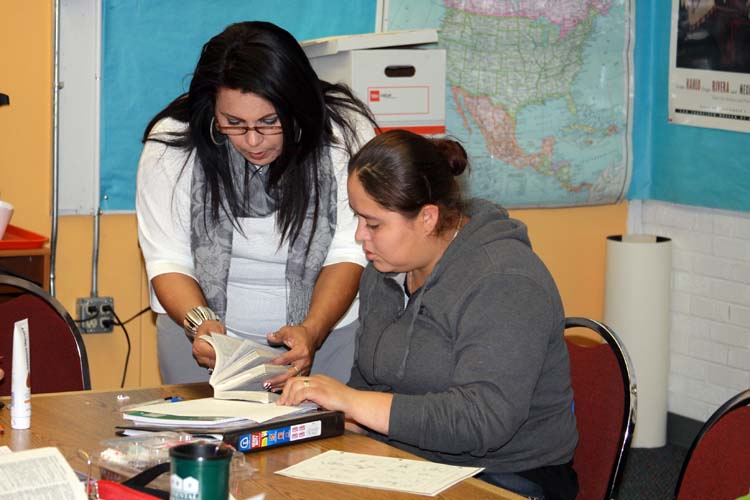 Lidia, a program participant, brought me tamales one day, made from her special recipe con chiles y chocolate. (She was simply too nice, I might have mentioned my appetite—they were ricissimo.) In her tiny village Arroyo Tomate in Oaxaca, Mexico, Lidia grew up with 7 siblings and other family members in a rackety shack. There was no running water, the roof was leaking, and grocery shopping was a daytrip on foot to the nearest town. After she joined her husband in Phoenix, she felt helpless and alone. She spoke barely any Spanish—only her native Chinanteco—but she eagerly absorbed every new English word in Sandra’s class at UP. Lidia was a beaming lighthouse of gratitude.
 What a story! Only one of many. Most of the participants at UP come from a day laborer background and can barely afford medical care or school supplies. At UP these immigrant women learn their daily ABCs, while their toddlers and preschoolers follow their own structured programs. They want to improve their families’ lives.
 Stop here, we—you and I—really had it good. We could rely on a lot of resources, help, education, and chances in our upbringing and professional track. So I thought I should share my education in publishing to put together newsletters and a website. That was about eight years ago. The women at Unlimited Potential have always impressed me. They are struggling, they have little education, they speak in broken English, but they seem grateful and undaunted. They are bravely learning to navigate American society. Here are several more reasons why Unlimited Potential has stuck on me.


